We live in rough times. The world needs a good laugh.
This is the main impetus with which the idea for the Jonasquin channel was started in 2025. Here are some more aspects of my philosophy:
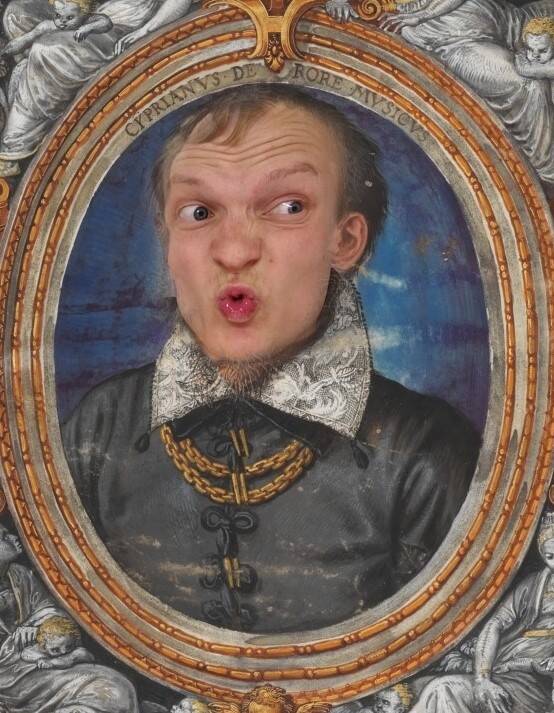
Ciprionas de Rore, attending one of Jonasquin's singing classes
I am not a professional singer.
This is no false modesty. While I can do the job well in composing in the styles and genres I am presenting, I know that my singing skills don’t reach up to that level. 12 semesters of obligatory singing classes during my university programs unfortunately couldn’t do the job in enabling me to develop the voice that I would love to have for this style and for which I envy every pro singer.
To be more specific, the problem is not that I wouldn’t be able to sight-read my own pieces (as would be due in my function as an ear training teacher). The problem is more the control of the voice, of the breath, of the resonance spaces within the body – all the techniques a professional singer is supposed to have. I know my limitations and I experience them regularly when recording.
In an ideal world, there would be a professional early music ensemble (mainly vocal, but of course also instrumental at times) that I could call together every other week to perform and record my pieces for me (and I would have the money to pay them). Since this is not a realistic perspective, but I intend to release my pieces on a regural basis anyway (see the quantity paragraph), the only solution that there is for now is to record the pieces on my own, even if that means I have to sing alto and soprano parts (my only comfortable range being bass).
Since I am recording all or most of the parts of a piece seperately, I don’t regard the resulting audio files as choir pieces. In an ensemble live recording, there would be many differences: the blending of the voices, the dynamic and rhythmic nuances, the feeling… I would love to hear more of my pieces in a real life context, but this is nothing that I can beg for. On the other hand, I am extremely happy to share my pieces at all, even if that means that they are only available in their more sterile, artificially enhanced aesthetics. I can only guess of course, but as far as I can tell many of you prefer having the pieces as they are, if the other choice was not having them at all.
Production process – from sketch to final video
Every project starts with a song that makes me wonder how it would sound in a historical style for days on end. When the melody just asks for it, when the text has some nice expressive passages, or simply if I have to laugh at the mere thought. That’s when I know this is something that I want to dig deeper into. From time to time, ideas come to me through students who, mostly joking, pitch me their thoughts directly (e.g. Who Let The Dogs Out), or I scroll through the google document provided to my YouTube community (see the links and resources page).
Usually, I write my composition directly down into finale (still using) and record all the parts afterwards (or have it recorded by a collaboration partner, see people). The recordings are cut together to one track per part, which then undergoes a diligent intonation and timing correction process (using melodyne). Haters will call this cheating or wrongly label it as „autotune“ (if you want to know why this isn’t the same, watch the video essay by sideways). I personally use melodyne as a tool that enables me to make my voice(s) sound blended the best possible way for a project that at its core is a digital product, and I would have very different standards if I was part of an ensemble that performs these arrangements live (see the professional singer paragraph above).
With all parts recorded and the most obvious contrapuntal errors corrected, I turn to my personal sound designer Valentin. Valentin can do a lot of things that I cannot, first and foremost the effortless navigation of a DAW. He can hear many things that I cannot hear, he has an extremely high production standard, and best of all: he is musically literate and knows his music theory (not something one can take for granted from a sound designer). You can find out more about him here: https://schvld.com/
When at least a preliminary audio version is produced, I turn towards video shooting. Each part is filmed seperately and then cut together in davinci resolve. For me, the score is the center of the video, the wobbling heads around it serve one of the following two functions. The first one is actually pedagogical: in depicting visual singers, I hope to help viewers understand the structure of the music, for example the imitatory patterns, the use of Cantus Firmus, the exceptional dissonances. The second function is to underline my main philosphy: that – at least – not all of this is to be taken entirely seriously.
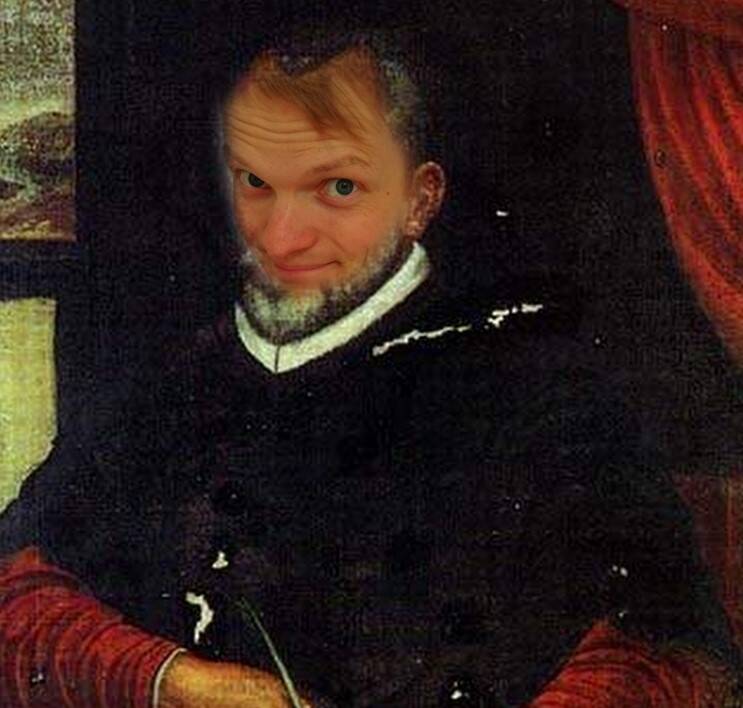
Gionni Pierluigi da Palestrina, composing his 4597th mass
Quantity
Launching a YouTube channel in 2025 is a different story than in 2015 or even 2020. One competes with the massive amount of A.I. slop uploaded every minute, and users are – legitimately – very suspicious about channels they haven’t encountered before. Also, the YouTube algorithm is very bad at detecting the ideal target audience, especially in such a niche genre that people typically won’t search for on their own. One of the ways to meet this challenge is to create catchy packaging for every video with the typical pointy thumbnails in order to make YouTube disperse the videos as widely as possible and enhance the chances that the target audience is included.
Therefore, I consciously decided to make a channel that publishes regularly, with a release every week in the beginning and every two weeks in the long term. This has vast implications: as described above, in this context it isn’t possible for me to have professionals perform in a way that would be more apt for this music. I „have to“ do most things on my own, depending more or less completeley on my abilities and disabilities.
People
At times, I am extremely happy to collaborate with dear friends and fans (some of which I never met before) who actually are professionally trained singers or instrumentalists (or both) and who are so kind to supply their voice (and face), their enthusiasm and professional attitude.
Thank you SO MUCH:
-
An-Chi Tseng
-
Anna Petrtylová https://www.zpivejsemnou.cz/
-
Beata Nawratil
-
Christopher Fischer www.fischer-tenor.de
-
Emilė Ribokaitė https://emileribokaite.com/
-
Franziska Blömer https://www.franziskabloemer.com/
-
Helen Buck
-
Jule Klessing
-
Jule Valerie Hamp http://julevaleriehamp.de/
-
Kathrin Härtel https://www.kathrinhaertel.de/
-
Sarah Puttkammer
-
Tabea Bös (all round partner in crime and life, biggest emotional support) https://www.instagram.com/tabea.tabbl/
-
Ginny (best early music cat in the world)
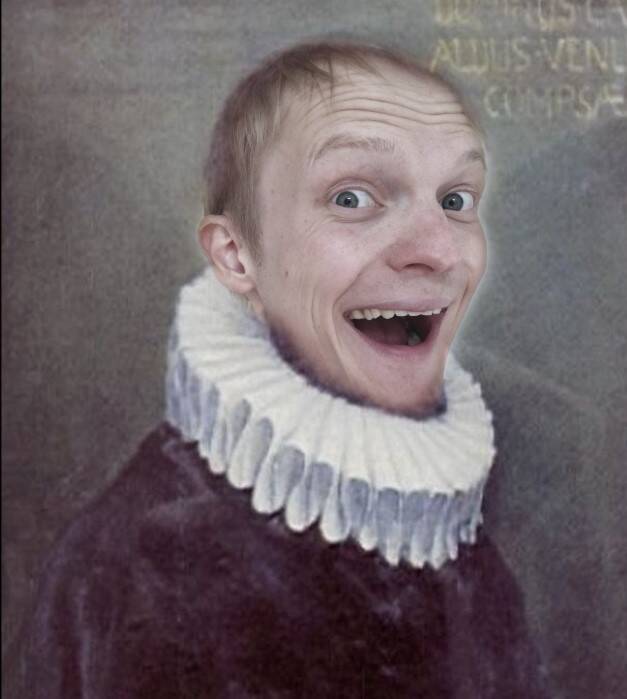
Carlo Gesualdo da Jonosa, occasionally a nice guy
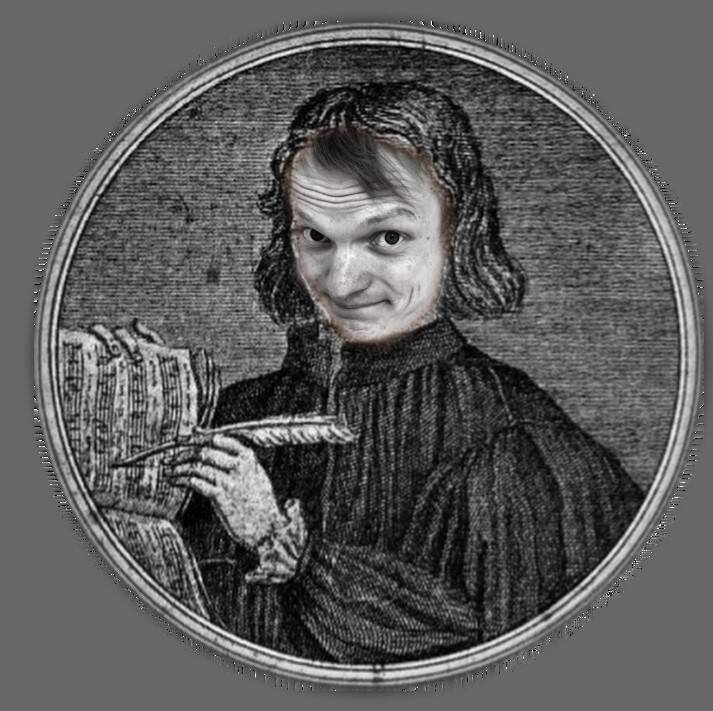
Jonas Tallis, marking counterpoint errors of his students
Influences and Idols
The number of channels on YouTube with arrangements „in the style of“ is vast, but only very few had a meaningful impact on me and inspired me to do what I do:
-
Giovanni Dettori: the godfather of fugues over pop music derived themes, without whom, as far as I can tell, this wouldn’t be its own genre on YouTube.
-
Peter Breiner: besides Joshua Riffkin and John Bayless probably the only one who published this style of crossover pastiche in the professional music industry, and he has dedicated four consistent albums to it! Even if his Beatles concerti grossi are not completely stylistically accurate, they have shown me a large spectrum how period inspired compositions can be made and can work in the context of professional concerts.
-
Postmodern Jukebox: one of the very few groups that managed to transform a large amount of songs I never liked into all time favourites.
-
Arthur Wilkinson: His „Beatle Cracker Suite“ is probably the best possible form of cognitive dissonance one can be exposed to.
-
Next, there is a piece called „Masterpiece“ by the British composer Paul Drayton. As the title suggests, „Masterpiece“ is a modest title for a piece with modest pretentions.
-
Florian Wagner: German piano comedian who has a few „how would Beethoven have composed…?“ in his repertoire.
-
Ben Comeau and his Donald Trump fugue, for reasons obvious.
Generative A.I. policy
Over the last couple of years, the internet has been flooded with cheap, meaningless slop. This channel aims to create art that is human made throughout, with every step in the creative and performative process covered by skill that several human persons have acquired through a long and sometimes very exhausting journey. It also aims to create art that will not be overtaken by Generative A.I. in the forseeable future. (I personally don’t believe that what I do cannot principally be „learned“ by Generative A.I. but since the market for this niche genre is so small the big A.I. companies at least don’t have any interest in training their models.)
The only territory where A.I. usage is imaginable to me is A.I. enhanced tools and plugins in the digital audio work station.
Erstelle deine eigene Website mit Webador